Contents
-
Imperfect Congruence
- A mathematical note
- About the author
- Part 1: Kepler and the regular polygon tilings
- Part 2: Rhomb/rhombus/rhombic tilings
-
Part 3: A universal tiler
- Fans and other rhombic structures
- Regular polygon decomposition
- Regular polygon decomposition (odd)
- Worms and zonagons
- Decomposition algorithm
- Decomposition mathematics
- Variations on the universal tiler
- The regular polygon extension theorem
- The triangle extension theorem
- The rule of two
- The vertex figure extension conjecture
- Vertex figure extension examples
- More vertex figure extension examples
- Part 4: Five-fold symmetry
- Conclusion
- Tiling Gallery
- Appendix: Bridges conference
- Appendix: Proof of the Gap Theorem
- Appendix: Tiling source code
Art - a 3.9.18 tiling
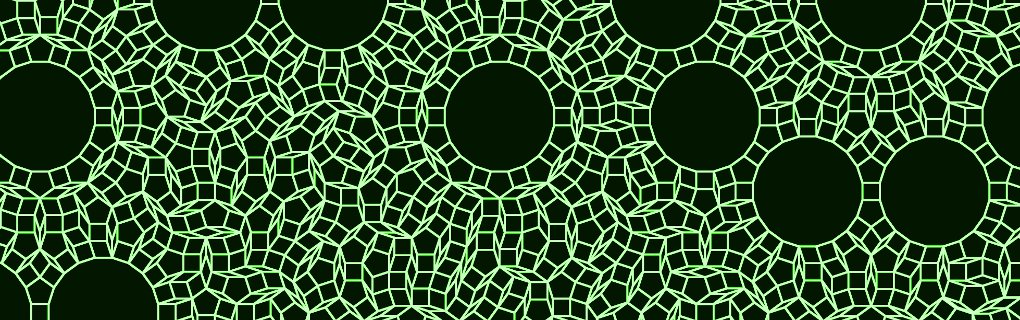
This tiling, sent to me by Robert Fathauer, has one of the simplest translational units of any of the tilings extended from “forbidden” vertices shown on this site. It also has one of the smallest prototile sets with only 4 elements.
After Robert Fathauer sent his original image to the Tiling Listserv, the University of Waterloo mathematics professor Craig Kaplan pointed out that this simple tiling is the foundation for the much more elaborate motif with 9 and 18-pointed stars found in some Islamic art.
This tiling is constructed from a very simple nutshell consisting of two 18-gons alternating with two nonagons. The “nut” inside contains 4 triangles and a single 4π/9 fractional rhomb:

Tiling

Translational Unit

Legend

Skeleton tiling

Tiling (Black and white)

Translational Unit (Black and white)
